
Three to see
Face jugs, fabrics and a play of color and light

April 3/2026
Back from a long trip and catching up. How was all the stuff I missed?
On with the shows.
A brief look back at Peter Lenzo’s life and art
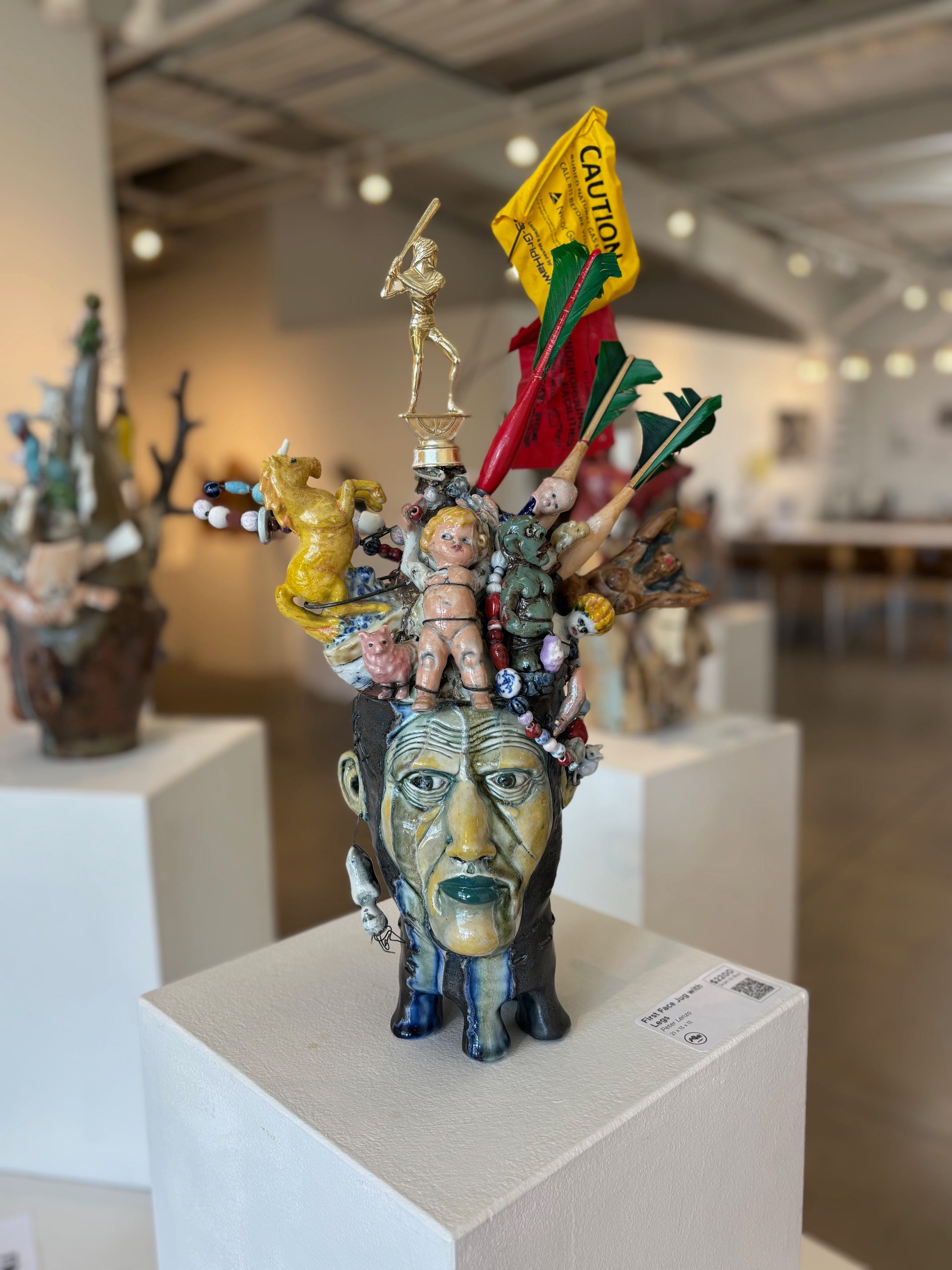
“Peter Lenzo: A Retrospective and Remembrance” is made up primarily of the unique and very personal face jug sculptures by the late artist who was a long-time resident of Columbia. The exhibition at Stormwater Studios was co-organized by Lenzo’s daughter Roxy Lenzo Douthit and the Jasper Project. In it are about 30 face jugs, a few altar-like sculptures he was making just before the jugs, and an even earlier large photo piece predating the altars (which often included photos.) Lenzo came to Columbia in 1992 to teach at USC and later became a middle school art teacher.
There’s an opening reception tonight.
A few years after arriving in Columbia he developed a disorder that caused him to have seizers and affected his memory and daily functioning, but he kept making art.
The face jugs grew out of a demonstration he was giving to his students and he saw their potential after giving one to his then young son who immediately began sticking a bunch of stuff to it. The face jugs turned out to be the perfect vehicle for his art that addressed the “brain storms” (which is what seizures are) and every one is a kind of self-portrait. Starting with a basic face jug he’s manipulate the features, build upward and outward, sometimes adding more heads and bodies, often attaching found objects (usually ceramic figurines). He also frequently wrote on the backs of the jars, documenting what was going on, especially in his brain, at the time of their making.
Still active in spite of his illness, Lenzo spent the last years of his life in the Chicago area. He died in October 2024.
The work is quite powerful – well-crafted, mesmerizing to look at and often disturbing. You could probably spend 30 minutes looking at each piece they are so very detailed and packed with layers upon layers of material and meaning. The works are not dated on the labels but seem to be from his early days of making face jugs to the year of his death. Due to space and the safety of the objects, the backs of the jugs (with text and dates) are generally not visible which is a loss for the viewer. I was always a big fan of Lenzo’s altarpieces so am happy to see some of those in this exhibition.


This is the second local short run show (it closes April 12) of Lenzo’s work (the other was last summer at the USC School of Art and Design gallery.) Both of these exhibitions are/were quite good, but it would be great to see a larger art organization/museum, step up and do a more extensive exhibition about Lenzo’s art and life.
The Jasper Project is publishing a catalog/book in conjunction with the show along with a film about Lenzo’s life that will be shown April 10.
A fresh take on textiles
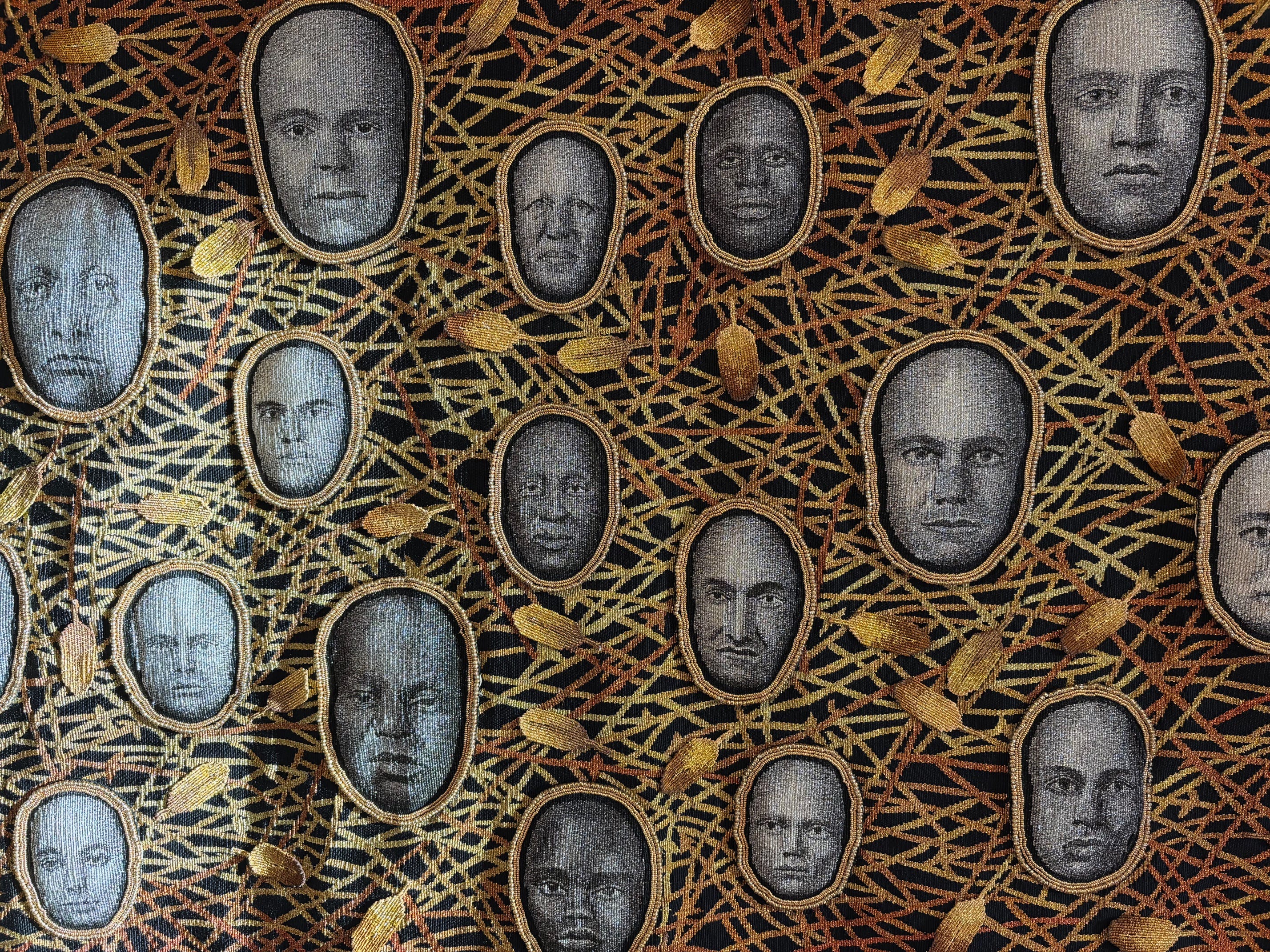
By Hand & Machine is a fiber exhibition, but probably unlike one most have seen. The exhibition by six artists at the 701 Center for Contemporary Art is part of a year-long nation-wide project titled Handwork 2026 celebrating craft during the nation’s 250th anniversary. (There are hundreds of exhibitions and related events taking place; a second show from the project will be at CCA later this year.)
This is a show of beautiful works created using a wide range of techniques with rich and varied content from the more traditional to out there on the edge. The couple of dozen pieces are very well displayed, along with a few tools of the textile trade. There are also several succinct text panels explaining techniques used in making the works.
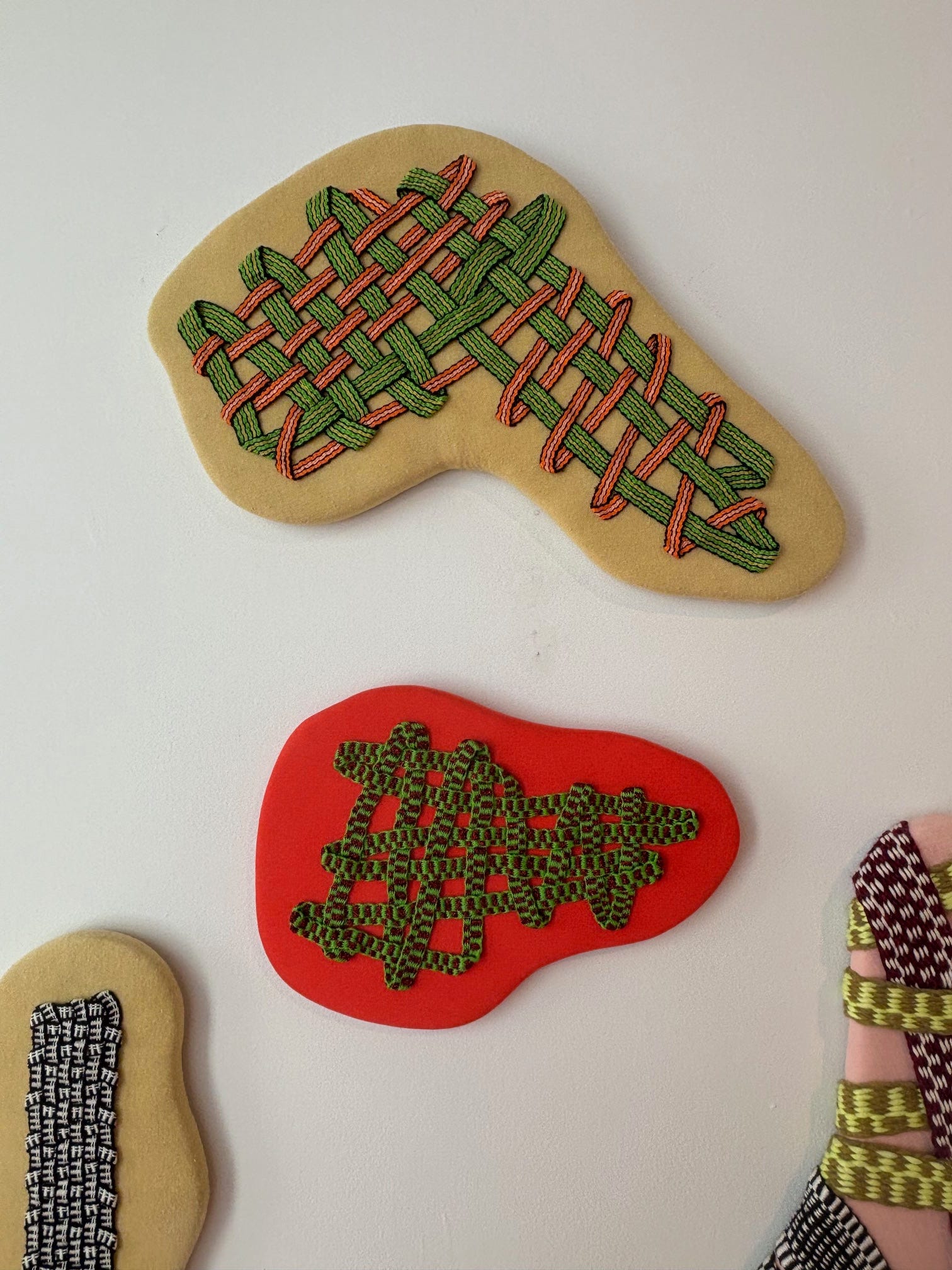
One of the artists, Cristine Tedesco, has long been a presence in South Carolina, with her very modernist (it’s no surprise she studied architecture) quilted pieces. A more funk-oriented artist, also living in the state, is Kristy Bishop, who creates crazy colored and oddly shaped works. Those two give an example of how diverse this show is. Great to look at; great to learn from.
When I posted a bit about the show a few days ago, I got several responses singing the praises of one of the artists in the show: Jon Eric Riis. (Example: “If you have never seen the work of Jon Eric Riis, you are missing an amazing experience.”) They were right.
The exhibition was curated by Harriet Green, who is on the Handwork planning committee, an art consultant, advisor to 701 CCA, an American Craft Council board member and former long-time visual art director at the South Carolina Arts Commission. Along with the many exhibitions and events it is mounting, Handwork has many many collaborators including PBS (it has completed a program on artists in the East and West and is working on North and South), the Smithsonian, Americans for the Arts and American Craft Council.
There is suppose to be a panel discussion with some of the artist during the run of the show (it ends May 17) and an concert of improvisational music with players responding to the works. Keep an eye on the CCA website for details.
Complex eye candy from recent USC grads
Two fairly graduates of the USC School of Visual Art and Design master of fine arts program have very engaging shows at Columbia College Goodall Gallery.

The main space is occupied by the Anna Byars’ gargantuan paper works of kaleidoscopic colors and shapes. I’ll admit that I do not quite understand how they are made, but the labels say “Blind contour drawing; digitally painted and mirrored; archival pigment print on mulberry paper; hand-sewn.” And they are all that. Fascinating work, although not all the pieces seem of the same body/mind.
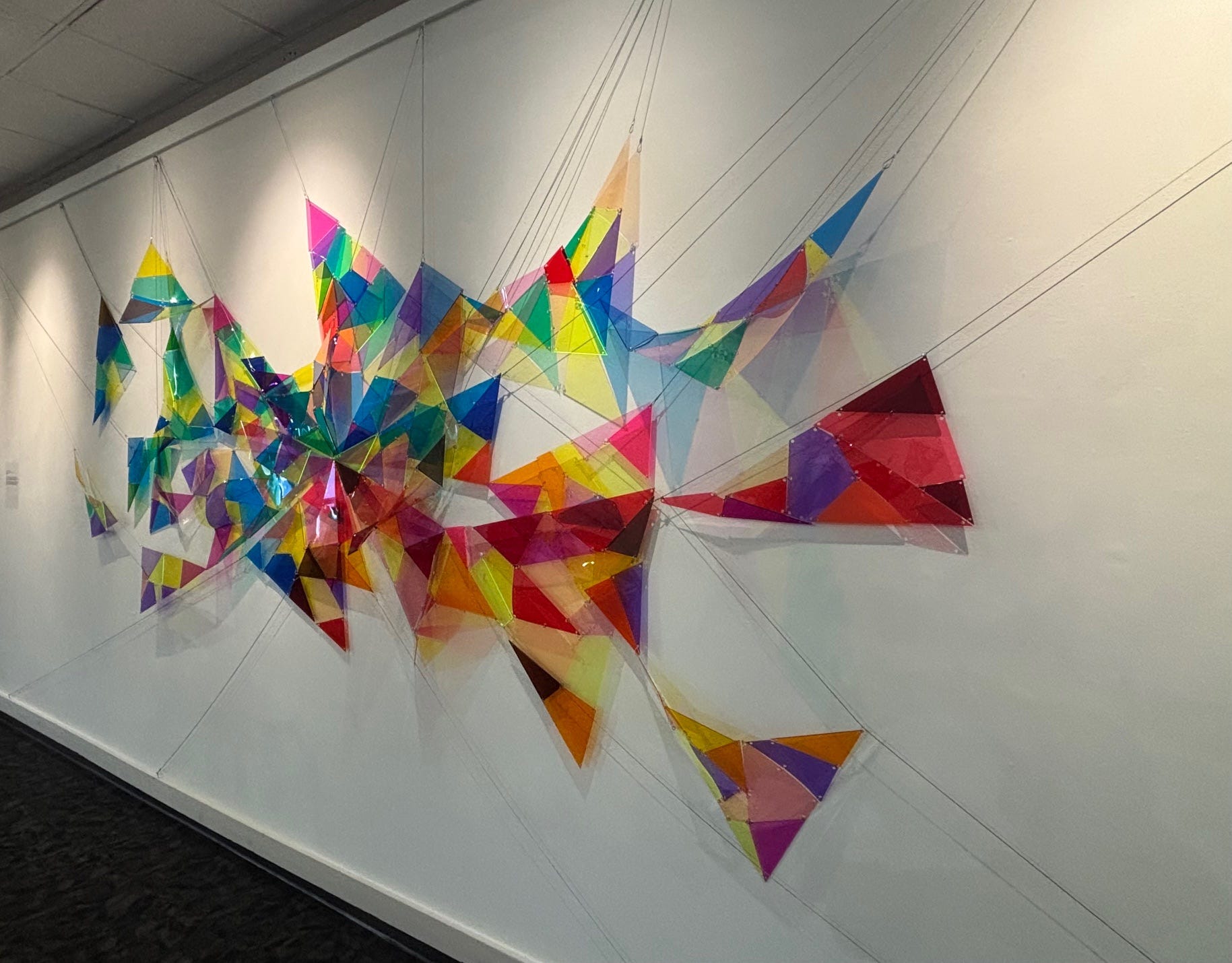
In the smallish loft space is the work of Addison Graham; and it is “work” singular. is a structure of small multi-color Plexiglas panels joined together with wires and handing from the wall with more wires. It’s the perfect work for the space. I’ve seen some of her work before, shown outdoors where natural light plays an important role, but to me this is the most successful
The shows, together titled “Luminescence,” are up through April 20.
I have added info on the curator: The exhibition was curated by Harriet Green, who is on the Handwork planning committee, an art consultant, advisor to 701 CCA, an American Craft Council board member and former long-time visual art director at the South Carolina Arts Commission. And she doesn't call herself a curator.
Thank you Jeffrey for the wonderful article!